Quick Summary: Automotive Aluminum Alloys have become the cornerstone of vehicle lightweighting in the era of New Energy Vehicles (NEVs). Key applications include battery trays, BiW, and chassis components.
As the global automotive industry pivots toward “Dual Carbon” goals and New Energy Vehicles (NEVs) dominate the market, aluminum alloy has emerged as the cornerstone of automotive lightweighting. By replacing traditional steel, aluminum offers superior performance in weight reduction, energy efficiency, and range extension.
1. Automotive Aluminum Alloys in Body-in-White (BiW) Systems
The vehicle body accounts for approximately 30% of total mass, influencing nearly 70% of fuel consumption.
Pioneering Technology: Audi’s landmark all-aluminum A8 and A2 models proved that aluminum can reduce body weight by up to 40%.
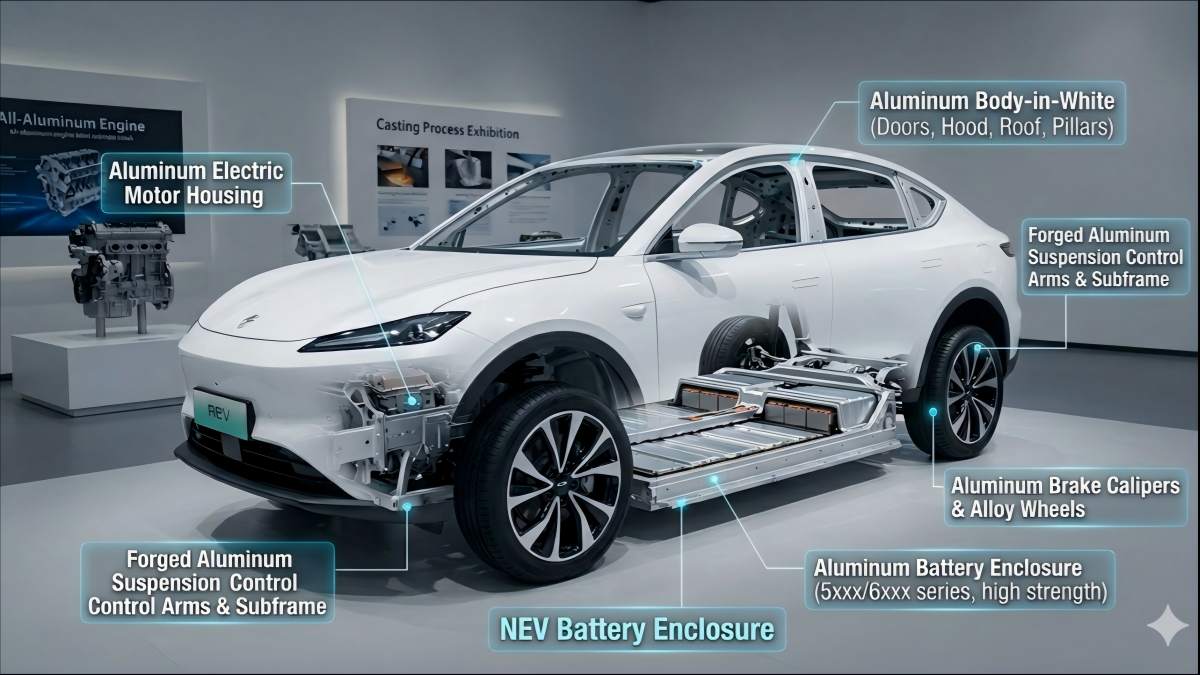
6xxx vs. 5xxx Series: Modern NEVs like Tesla and NIO utilize 6-series alloys (6014, 6016) for exterior panels due to their excellent stamping and baking performance. Meanwhile, 5-series alloys remain the standard for complex internal structural components and inner panels.
Key Applications: Hoods, roofs, doors, fenders, and A/B/C pillar reinforcements.
2. Chassis & Suspension: The Low-Hanging Fruit of Lightweighting
The chassis offers the highest potential for immediate weight savings. Transitioning from TRIP steel to aluminum significantly reduces unsprung mass, improving handling and heat dissipation.
| Component | Aluminum Advantage |
| Subframes | Improved rigidity and reduced vibration in high-end models. |
| Control Arms | Forged aluminum offers high strength-to-weight ratios for better response. |
| Brake Calipers | Faster thermal dissipation and quicker braking response. |
| Wheels | Every 1kg saved on wheels can increase range by 800m per liter of fuel equivalent. |
3. NEV Battery Enclosures: The New Powerhouse
In New Energy Vehicles, the battery system accounts for roughly 30% of the vehicle weight, with the enclosure (battery box) making up 20% of that total.
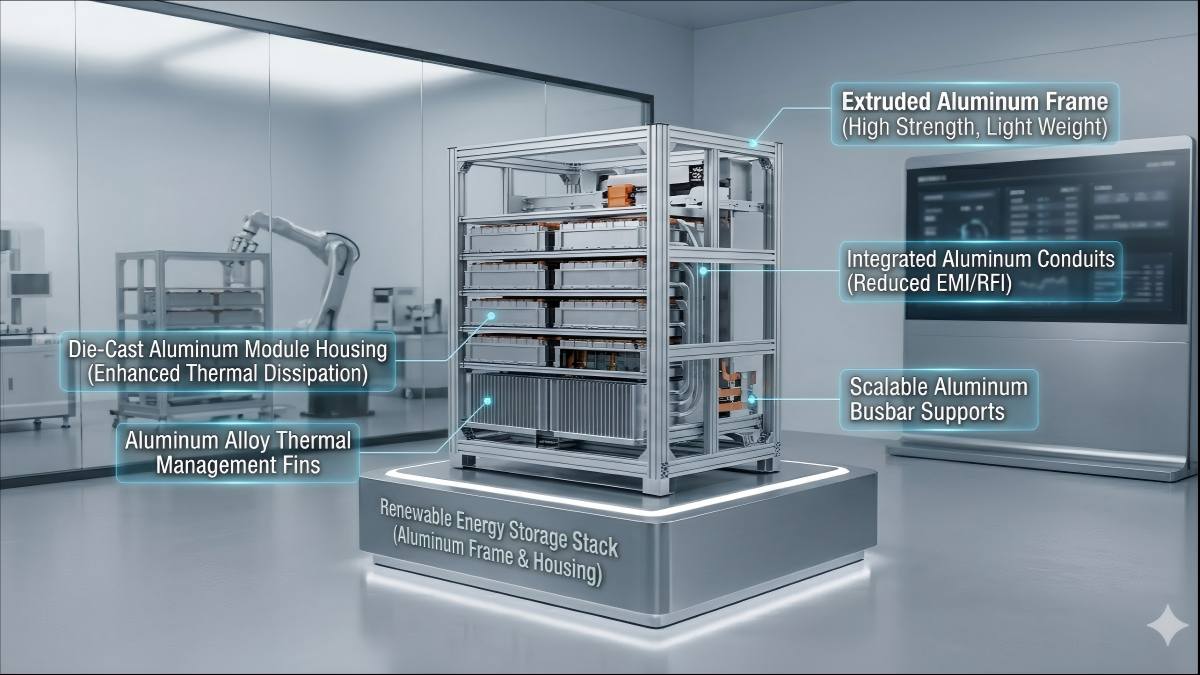
Leading manufacturers—including BYD, CATL, and Tesla—now utilize aluminum die-cast trays and extruded frames. This provides the dual benefit of high structural protection and optimal thermal management for lithium-ion cells.
4. Powertrain & Thermal Management
Engine Components: Aluminum remains the standard for pistons, cylinder blocks, and heads to reduce reciprocating inertia and enhance cooling.
Transmission Cases: Aluminum alloys reduce the weight of the drive system while maintaining the stiffness required for high-torque outputs.
Heat Exchangers: Radiators and condensers rely on aluminum’s high thermal conductivity to manage the intense cooling demands of modern motors.
Future Trend: Integrated Die-Casting (Giga-casting)
The industry is moving toward Integrated Die-Casting. This technology replaces dozens of individual stamped components with a single large-scale aluminum casting, significantly simplifying the assembly process and reducing costs.
The Road Ahead: Challenges and Innovations
To further unlock the potential of automotive aluminum, the industry is focusing on three key R&D pillars:
1.Heat-Treatment-Free Alloys: Essential for large-scale integrated die-casting to maintain dimensional stability.
2. Material Simplification: Reducing the variety of alloying elements to improve the efficiency of end-of-life recycling.
3. Composite Micro-alloying: Enhancing the stamping limits of aluminum sheets for more aerodynamic body designs.
Conclusion: Aluminum is no longer just a “premium” material for luxury cars; it is the fundamental building block for the next generation of sustainable and high-performance mobility.
Why is 6061 aluminum used in cars?
6061 aluminum is widely used in automotive frames and components due to its excellent strength-to-weight ratio and corrosion resistance.